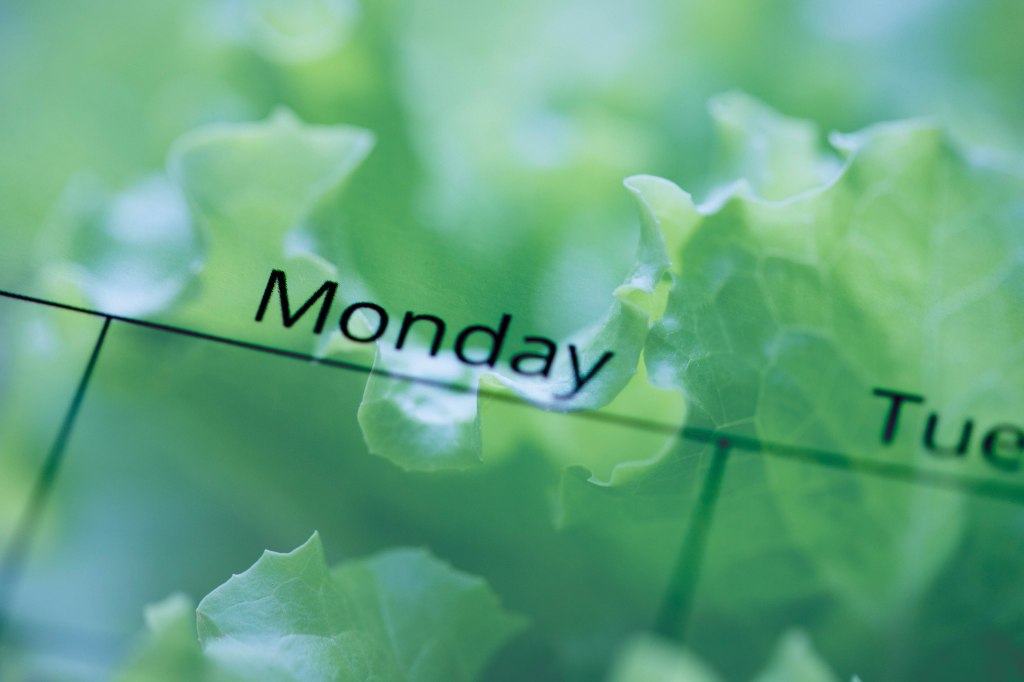
You’ve probably heard about Meatless Monday, a campaign or, as the Mondays folks call it, “a global movement,” that encourages people to reduce their meat consumption “for their health and the health of the planet.” It’s a great idea and easy to do.
It’s true that a plant-based diet has health benefits. This message has been promoted for some time by people like Dr. Neal Barnard of The Physicians Committee for Responsible Medicine, sponsors of the 21-Day Vegan Kickstart program. As noted both there and on the Meatless Monday website, there is evidence that reducing meat consumption can lower a person’s risk of heart disease, type-2 diabetes, and other chronic health conditions.
It’s also true, as outlined on the Meatless Monday website, that animal agriculture has an enormous environmental impact that a reduction in overall consumption and demand would help to moderate. For example, livestock (especially ruminants such as cows and sheep) produce a lot of greenhouse gases. They are also water-intensive, requiring much more water than the equivalent amount of vegetables. Run-off from manure lagoons, required for storing the immense amounts of waste generated by industrial animal farms, contaminates our waterways. Besides being water-intensive, industrial livestock farming is land-intensive. Forests, including rain forests are cleared of trees to create grazing areas and land for feed crop production. This in turn causes a loss in biodiversity, destroying natural habitats. Soil microbial biodiversity is also at risk, contributing to climate change and food security.
That’s a quick summary, but the overall message from the Meatless Monday campaign is that a plant-based diet, if widely-embraced, offers a more environmentally sustainable way of eating.
Of course, Meatless Monday is a way of easing into plant-based eating once-a-week. The goal is reduction, not elimination, of meat consumption by committing to giving it a go on Mondays. The website offers resources, not just in the way of information about the benefits of a plant-based diet, but also in the form of recipes, like watermelon gazpacho and artichoke panzanella salad and grilled avocado with salsa. The recipes aren’t fully vegan, with some containing eggs or dairy (mostly optional). But for someone who is experimenting, it’s a great start with compelling info about health and the environment.
The reason it’s only two-thirds there, in my view, is that there is no mention of any ethical concerns about factory farming in relation to animal suffering. While I can understand why attracting an audience might mean not making that the main focus, it is odd not to mention it at all. That’s why in the scheme of things the information on the Physicians Committee for Responsible Medicine is more comprehensive. While they do of course talk a lot about health, they also have a lot of information about “ethical science,” including the use of animals, alternatives to it, and even information about cruelty-free cosmetics.
I grant that the comparison of Meatless Mondays to the Physicians Committee for Responsible Medicine is not apples to apples, given that the PCRM is explicitly promoting veganism. Meatless Mondays is a campaign for reducing meat consumption, not switching to veganism. For some people even the one whole day a week will seem radical and will take some careful planning. For others, it won’t go far enough.
My hope for people who are taking a first step into Meatless Monday as an experiment is that they will discover that it is not as difficult as they might first imagine it to be. Indeed, over time, it might become a fun day to look forward to, an opportunity to try new recipes, while at the same time doing something with health benefits and a positive impact on our planet. That could, in turn, result in more meatless meals on other days of the week. As more people join the movement, and as more people extend it into other days of the week, the benefits will multiply.
So even if I believe there are good reasons to go beyond Meatless Monday, I am happy that these moderate movements exists. They make eating plant-based something to try, while offering great resources that explain some of its benefits.
On Friday, I’ll post a few suggestions for Meatless Monday menus–breakfast, lunch, dinner, and snacks.
 Vegan Practically
Leave a comment