
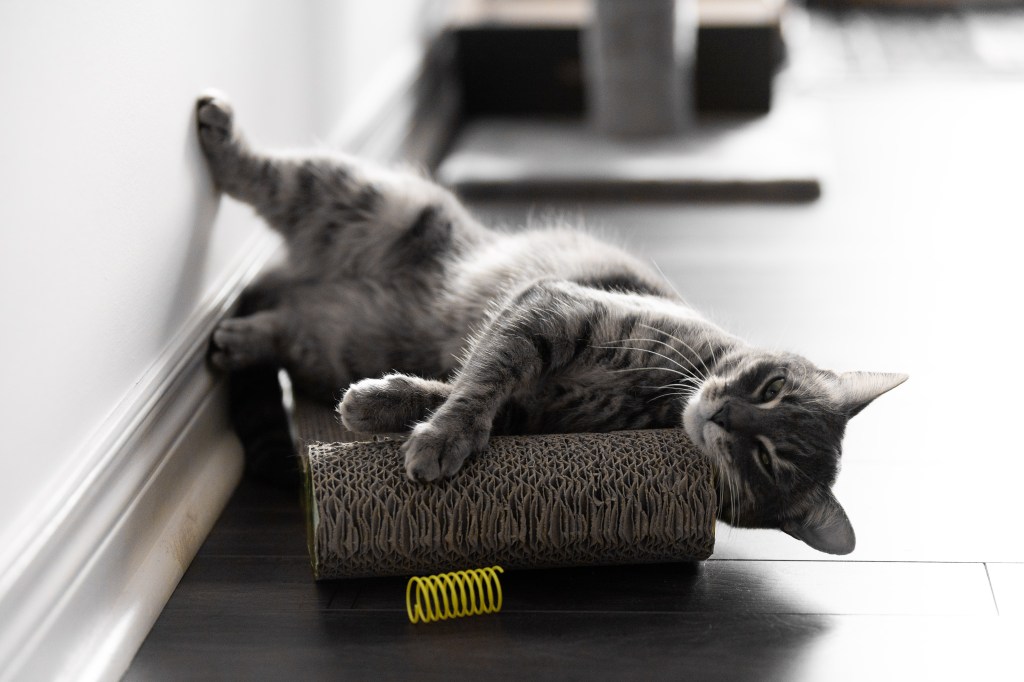
Full disclosure: I have two cats who were rescued from a feral cat colony when they were just days old. The rescue agency spayed their mother and fostered the kittens, then adopting out to me. I love them and think they have deepened my humanity. As far as I can tell they love me right back. In fact, Rosie hides from almost all other humans but is a social darling when she’s with me. Lily has epilepsy and has fewer seizures than she otherwise would because of daily anti-seizure meds. I feel strongly that we are all better off than we would have been otherwise. But that doesn’t mean there is nothing to be said about the moral issue of whether humans should keep non-human animals as companions.
I’ve blogged about pet abolition before (sort of — there too I said “no”). I’m here again because I have been thinking a lot about abolition of institutions lately, having just taught a segment on marriage abolition (where we read Clare Chambers’ wonderful paper, “The Marriage-Free State”). That means I have recently witnessed how tightly humans cling to institutions that are historically and very possibly inherently harmful and oppressive to large segments of the population. With respect to marriage, it seems to me ultimately indefensible to defend its privileged status as a state-regulated institution that comes with a slew of automatic entitlements that unmarried people do not have. I have experienced this myself of late, where my American partner and I would literally not be able to reside year-round in the same country without getting married and one of us applying for permanent residency in the other’s country (she is moving to Canada as a Canadian permanent resident in May).
But to pets. I was recently tagged on a post on the Biopolitical Philosophy Facebook group, linking to philosopher Richard Healey’s article, “Pets and Power: Why It’s Wrong to Keep Pets.” The main line of reasoning in the article is that there is a dramatic power imbalance between human and non-human animals in these companionate relationships, wherein humans hold most of the power. This asymmetry, the argument goes, gives them illegitimate control over all aspects of the non-human animals’ lives. The author states: “When we consider what could justify our upholding a practice that instantiates systematic relations of asymmetrical power between humans and millions of non-human animals, we come unstuck, for three reasons.” He states that these reasons support “pet abolition,” not with respect to existing pets, to whom we owe a good life, but with respect to the future of the institution of keeping pets because it cannot be rendered just.
The proffered reasons are:
- Power differentials of this kind can’t be well-defended by reference exclusively to the interests of the person holding all the power. We typically think that the person over whom the power is held must benefit. Upshot: “Centrally, human interests in keeping pets cannot contribute toward a satisfactory justification of those relations.”
- “Second, in keeping pets, we systematically set back their interests in having control over their own body, actions, and environment.” In other words, they are not free to pursue their own interests in the manner in which they wish to. Rosie and Lily, for example, as is frequently the case in North American cities, are indoor cats. This is for the sake of the birds and for the sake of Rosie and Lily. But they would no doubt love to spend time outside, marking out a territory, exploring, and killing birds and rodents.
- Our power over our non-human animal companions makes them vulnerable to harm. We’ve all seen stories or perhaps even witnessed cruelty or neglect towards domesticated animals kept as pets. Their high level of dependence makes them vulnerable.
I am aware that people have offered all sorts of “mutual benefit” arguments to support things like slavery, exploitative labour in the global market, and the continued exploitation of domesticated farm animals for food and other human uses. These arguments usually justify the continued practice of the status quo on the grounds that, because of the relationship of dependence that has contingently evolved, enslaved individuals, exploited workers, or factory-farmed animals wouldn’t have a life that met the basic necessities if it weren’t for the slave-holders, the multi-national corporation. I grant that they’re not strong arguments in general, and they’re less convincing in some cases than others.
I want to gesture in direction in some responses to the reasons outlined above, sometimes considering the mutual benefit line of reasoning as a possible direction to pursue.
First, the Healey article suggests that we don’t talk about the interests of the king or queen when trying to justify the power of a ruler over their subjects. We usually think that power-over needs to be justified in relation to the interests of the subjects. But surely we can invoke both sets of interests, and in many cases there is a balance at play. It’s not categorically wrong to appeal to the interests of the person who holds more power. I might have the final word, but I also spend a good portion of time serving and catering to what Lily and Rosie need and want (and in a way that is dis-analogous to the relationship of a king/queen to their subjects).
Many people I know have dramatically altered their lives and their schedules to meet the needs of the dog or cat in the family. If we can consider both their interests and the interests of the humans, it strikes a balance instead of the false dichotomy of justifying the relationship with exclusive reference to the benefit to humans. As Diane Jeske says in her chapter, “Humans and Their Animal Companions” in The Scope and Limits of Partiality (Oxford, 2024), “our relationships with our animal companions [do not] fall squarely into one category — say, that of friend–as opposed to another, such as guardian” but are rather complex and nuanced forms of loving companionship. As relationships with them grow and deepen, we develop additional reasons of intimacy to nurture and care for them well.
The second concern is that we set back the interests of our animal companions “in having control over their own bodies, actions, and environments.” I’m not a big proponent of the ideal and non-ideal theory distinction, but in this case it seems apt to point out that few cats or dogs would do better out in the wild than they do in their current environments. One need only follow Niall Harbison, who feeds and rescues street dogs in Thailand, to get a sense of how dogs fare when left to their own devices in the streets. Indeed, anyone who has lived with animal companions is aware that they continue to exercise a great deal of control over their bodies and actions, and frequently we cultivate environments that are friendly to their needs and interests. Though of course as I have said, Rosie and Lily can’t go outside, they are free to go wherever they want and there is ample opportunity for scratching and perching and climbing and running around playing zoom-chase.
The third concern is that their dependence makes them vulnerable to harm. Yes, this is the case. And this does pose a concern for which abolition strikes me as an extreme solution that dispenses with more than is necessary. By all means, have more oversight of these sorts of relationships. But total abolition would result in deprivation on both sides.
I haven’t addressed whether the simple fact of asymmetrical power is inherently unjust. I think, indeed I dearly hope, that our world can bear some just inequality and dependence. I think what I said to my students about marriage applies equally here: regardless of what we think about the institution of marriage, it’s not going anywhere. But that doesn’t mean we ought never reflect on whether its status as an institution to which we feel uncritically entitled makes sense. Nor does it mean it can’t be improved or differently appreciated.
In thinking about the asymmetrical power relationship between us and our animal companions, we might reflect more carefully on what that requires of us. And in thinking about the relationship as one of mutual benefit in which reasons of intimacy might strengthen our obligations to them, we might more deeply consider their interests in addition to ours.
 Vegan Practically
Leave a comment