

I just finished reading An Immense World by science writer Ed Yong. While it’s not immediately relevant to veganism, being more about animals in the natural world than about farmed animals, but it is worth a read for anyone who cares about animals and wants to learn more about how they experience the world. The book is a series of answers that riff off of philosopher Thomas Nagel’s famous question, “What is it like to be a bat?” (maybe it’s only famous among philosophers). Nagel concluded that, as humans, we cannot know what it is like for a bat to be a bat, that is, we cannot experience the perspective of the bat.
Yong renders the vast amount of scientific research on the sensory worlds of animals accessible to a curious lay audience in an engaging, well-researched, and way that conveys and inspires awe and wonder. His main narrative frame is the idea of Umwelt, from the German word for “environment,” used by zoologist Jakob von Uexküll to refer to an animal’s perceptual world — that which it can sense and experience (5). Taking us through smells and tastes, light/vision, colour, pain, temperature, contact and flow, surface vibrations, sound, echo-location, electric fields, and magnetic fields, Yong paints a picture of a rich and complex diversity of Umwelten, much of which defies human imagination because it is so far beyond the range of sensory experiences available to us.
I like this book because it makes me appreciate that diversity of experience is not only a diversity of human experience. When we break out of the ideologies that bind us to the conviction that humans are superior and that the way humans sense the world (which in itself is abundantly heterogeneous) is at the centre of all there is, we are offered a foothold for empathy and concern.
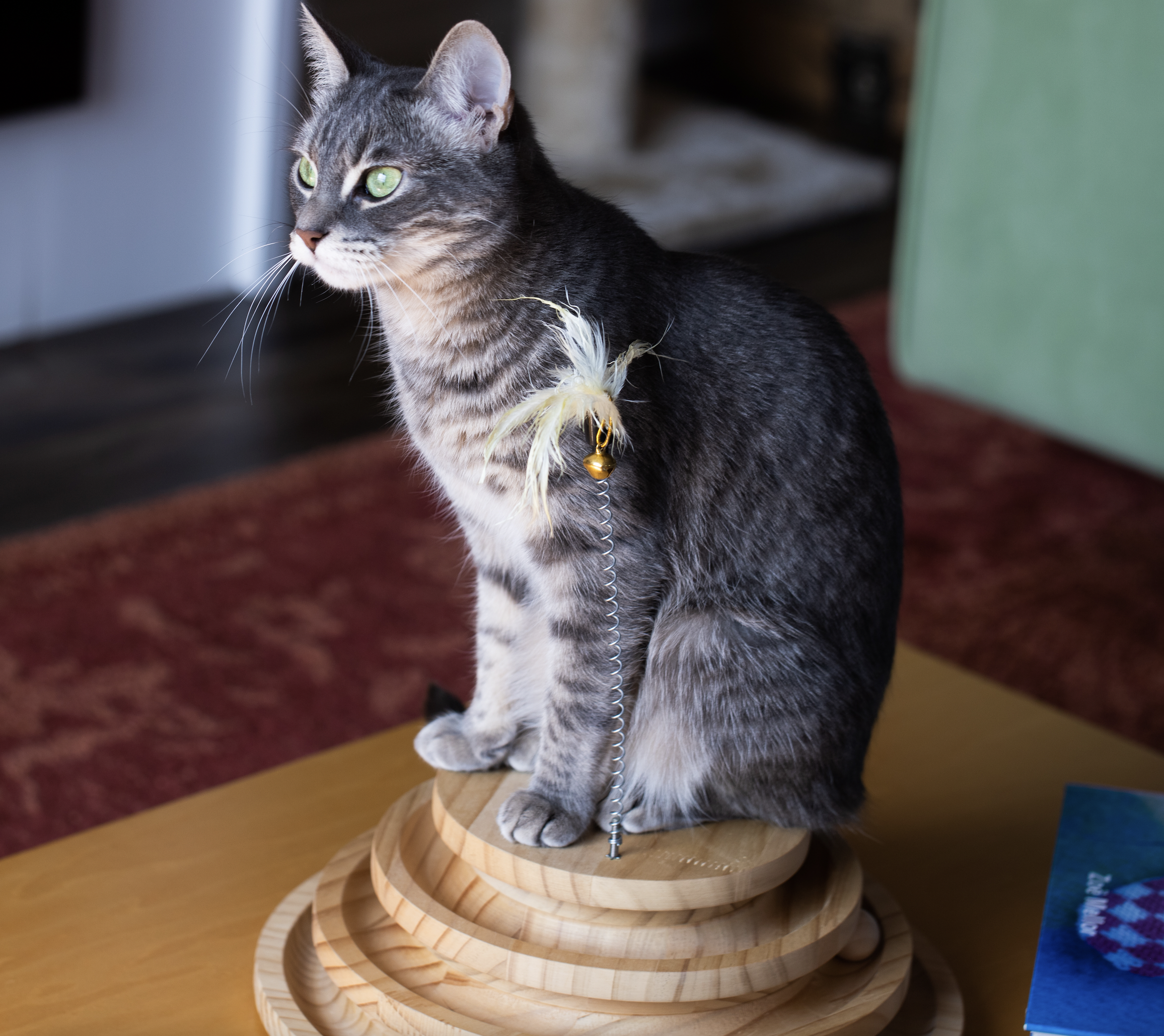
I think anyone with pets experiences this in some degree. I often look at my cats, Rosie and Lily, and think (or sometimes even say out loud), “what is going on in that head of yours?” They are clearly engaged with their surroundings in a way that I don’t fully grasp. If they catch sight of a bird, they bolt to the window. When I open the sliding door in the morning, they park themselves in front of it to take in the fresh air and the morning smells and sounds (such as they are from a balcony on the 23rd floor–ground level would be even more alluring, no doubt). They love interactive play, especially with “da bird,” a wand toy that mimics a flying bird. They can get lost in the experience of batting a toy around and chasing after it, performing their hunting instincts in the only way the life of indoor cats allow.

This book expands the area of fascination way beyond what is going on with the family pets (but not without frequent references to his trusty dog, Typo). In so doing, Yong invites us to consider the vastness of perceptual experiences constituting entire worlds that human experience can only inadequately map onto, if at all. He invites us further to consider the impact the current geological period, the human-dominated Anthropocene, has on these other Earthly worlds. Here he talks not only about climate change and greenhouse gases, but also about light pollution, the scarcity of silence, and the pollution of soil and water with unfamiliar molecules. Even something as temporary as the Tribute in Light art installation that shines in the New York City sky from dusk until dawn every September 11th, to commemorate that fateful day, has an enormous impact on the migratory patterns of songbirds such that “whenever a thousand birds or more are caught within the Tribute in Light, the bulbs are turned off for 20 minutes to let them regain their bearing” (339).
Though we may never know what it is like to be a bat or a migrating songbird or a newly hatched baby seaturtle or an octopus or an elephant or a whale or a dolphin or a mosquito or a bumblebee or seal or a hummingbird or a rattlesnack or sea otter or a dog or a cat, Yong maintains that our scientific knowledge and instruments allow us to dip into these other Umwelten. We should, he believes, regard this as “our greatest sensory skill” (354). Coupled with our curiosity and our imaginations, we can and should regard this skill as a cherished gift.
More than that, I think our ability to broaden our awareness beyond the human experience, even if only to understand and appreciate that other beings have their own lives and experiences too, is a nudge in the direction of respecting their status as inhabitants of this planet in their own right. They are not just here for us to have dominion over them or to live as unfortunate collateral damage to the human endeavour.
This book is an wonderful invitation to expand in that direction, attempting as it does to make some of those seemingly alien sensory worlds at least imaginable, even if we can’t grasp what it is like from the perspective of the being whose experience it is.


 Vegan Practically
Leave a reply to Nicole Cancel reply