
[Content warning: this post engages with a philosophical discussion that defends the killing and eating of non-human animals. Though I ultimately reject these arguments I present and explain them first.]
As noted in my blog welcome post, this blog is part of a larger project that includes, among other things, a book-in-progress. As a philosopher, I need to consider other, often opposing, philosophical positions as I try to refine my own. That means a lot of reading, including reading articles and papers that defend meat-eating. One such, contained in the collection The Moral Complexities of Eating Meat (editors Ben Bramble and Bob Fischer, Oxford 2015)), is a paper by Christopher Belshaw entitled, simply, “Meat.”
I have heard a lot of arguments in defence of meat, and so far I am not convinced by any of them. It’s tough to defend vast animal suffering and exploitation as it exists in the context of industrial meat production. It’s also hard to respond effectively to the increasingly powerful environmental arguments against the industrial meat industry. But I don’t know that I’ve encountered a less compelling argument than Belshaw’s, which is even worse than the “but it tastes so good” argument (hardly an argument, but still).
Belshaw’s argument focuses on a tenuous set of suppositions concerning (1) animals’ lack of a “desire for more life” and (2) the “tedium” of their adult lives, which he claims makes them not particularly worth living. I want to offer some comments on his claims here, and to do so I’ll need to explain some of his reasoning. Hence the content warning.
Admittedly, Belshaw notes that there is cruelty and exploitation in factory farming. He doesn’t have a lot to say about factory farming. He acknowledges that such animals “suffer a premature death, considerable pain throughout their lives, and considerable, and discomfiting, restrictions on their freedoms” (11-12). He cuts out of further comment on the grounds that there “is little point in either defending the indefensible or in attacking a practice that almost every reader here will already condemn” (12).
Belshaw establishes to his satisfaction that sometimes death will be better than life for an animal, such as when it is living in agony or when it will be living in agony at some point in the future (16). If we assume with Belshaw that sometimes death might be better than life for an animal, the question remains: Is it morally permissible to kill them? Many people accept it to be morally permissible, as we see in the case of pets that people frequently choose to euthanize rather than allow the pet to live to its natural death in pain. In some cases, he argues, we might even be morally required to kill them to “put them out of their misery.”
Is it morally permissible to eat animals whom we are morally permitted or required to kill? Belshaw believes it is. What are his reasons? He offers a spin on arguments from a philosopher named Benatar, who offers an anti-natalist view of human lives, the upshot of which is: we would be better off not having been born (bear with me; I’m not defending that claim). Let’s limit the discussion as it applies to animals farmed for food.
While vegans, vegetarians, and “Animal Liberationists” (his language) wish reduce or eliminate the meat industry, this is more about reducing the number of animals being born than about freeing them to roam as wild (so he argues). If these domesticated farm animals are not to be prevented from being born, then the humans who raise them need a reason to continue to let them be born. That we can eat them is a reason to keep letting them be born. There may be other benefits: aesthetic, environmental, or animal welfare-related. But in the end, Belshaw thinks “we get to eat them” is the most motivating reason for bringing them into being.
Ultimately, Belshaw argues that farmed animals, at least those on “traditional” farms or who are hunted, are not harmed and their lives are not worth living. Why say that? you might ask. His reason: “None of those we eat want, or have self-directed reasons, to live on. Nor are these lives, for their own sake, worth starting” (22). Given this context, “managed and early exits,” he argues, make sense.
Belshaw’s reasoning for why the lives of most animals are “not worth living” are so speciesist as to be difficult to take seriously. While dogs might have lives worth living because, after all they clearly have fun (all that chasing of balls and sticks), cats are different matter. Cats are “aloof; self-reliant; unwilling to be bullied into performing, fetching sticks, carrying newspapers; they are not anxious when left alone. Another way to view them is as dull and boring” (23). Kittens have fun, but adult cats…nope. He makes a similar claim about lambs versus sheep. Lambs — fun-loving little lovelies. Sheep–“mere eating machines” (23).
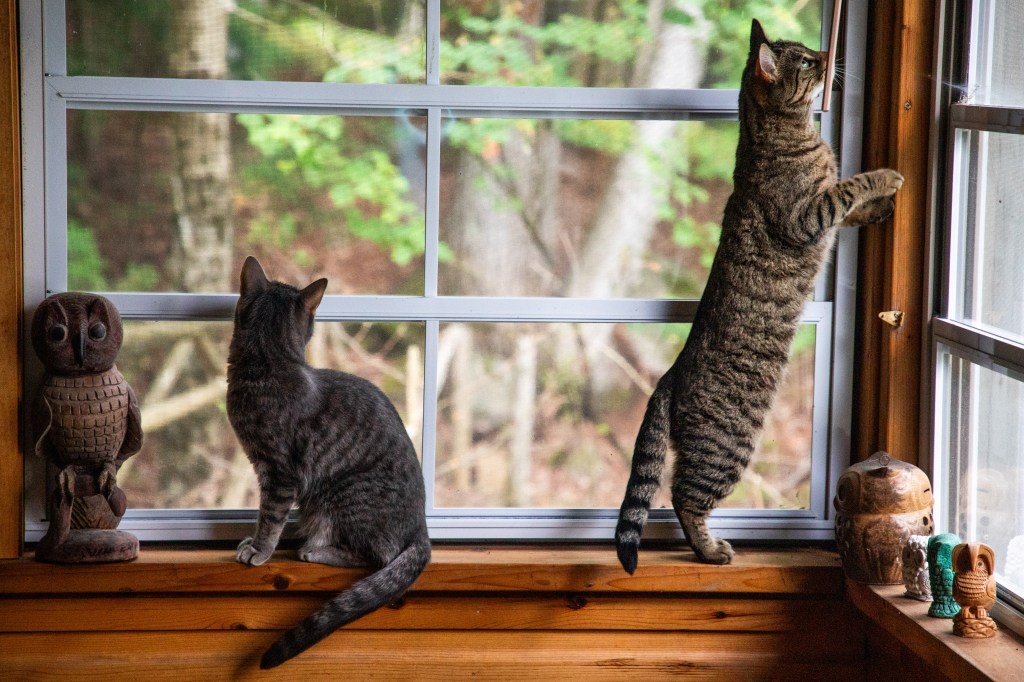
First of all, my adult cats, Lily and Rosie (pictured above in adventurer-explorer mode), are playful and social and fun and curious (and offended by Belshaw’s remarks!). And in any case, is he really claiming , in print, that the ONLY thing that makes animals “fun” and gives them lives worth living is if they perform for us? Secondly, just because we might not find it totally fulfilling to live the life of a sheep or a cat doesn’t mean they don’t enjoy their lives. I think it’s fair for me to base my rejection of this characterization of cats on my own cats (and the many reels of cats I’ve seen getting up to all sorts of mischief on Instagram) since Belshaw bases his own conclusions about these animal lives being “not worth living” on his “many years of observing farm animals outside [his] home” (23). He is untroubled that his reasoning applies equally to the lives of human babies–not worth living, by Belshaw’s measure.
Given his thoughts on the decline in farm animals’ engagement with the world as they pass from childhood to adulthood, Belshaw concludes that, provided they can have a pain-free managed death, “it isn’t bad for them, is perhaps good for them, and is very likely good overall when such animals have these short lives” (24). Since their lives depend on people wanting meat (or else they wouldn’t be born and raised at all), meat-eating is part of the overall picture without which they wouldn’t be born at all.
Let me just stop here and say that this is a terrible argument. It is, however, a more complex version of an idea that gets bandied about quite a bit: farmed animals wouldn’t exist without the humans that breed and raise them. That’s true. And if vegans achieved their ideal outcome, there would be far fewer farmed animals in existence to begin with. And then there would be far fewer beings living their lives in conditions of pain, confinement, and cruelty.
Let’s not forget why factory farming exists and why it is something to be reduced and ideally eliminated: it is a source of horror and atrocity, and in the context of global food production, it is vast. Factory farms produce an overwhelming majority of the animal products consumed in North America and Europe. In the US the figure is 99%. Worldwide, of 70 billion farm animals, 50 billion are on factory farms. Factory farming exists because of enormous demand for meat and other animal products. To base an argument for the continued existence of farmed animals on the “motive” of “we get to eat them,” sidesteps the simple fact that hunting and “traditional farms” don’t come anywhere close to being able to service the demand. [note: I am not here making any claims about the permissibility of hunting or “traditional” farming of animals for food]
Furthermore, the grounds on which Belshaw bases his claims that many or most farmed animals’ lives are not worth living, and that they don’t desire “more life,” demonstrate, among other things, a shocking lack of imagination and curiosity. I would recommend that rather than consider non-human animals only in terms that would seem of value to humans, he read An Immense World and allow himself a sense of awe about the diversity of experiences beyond the human experience.


 Vegan Practically
Leave a reply to catherine w Cancel reply