
I have had lots of opportunities to put catering under the microscope lately, and mostly it’s not been pretty. A colleague and friend elsewhere has been raving about a new menu item that’s been showing up at catered meetings in her workplace: an apparently delicious tempeh sandwich. This item deserves an A+ for being both delicious and protein-rich. It’s so good, she says, that the non-vegans have taken to eating them. Here’s a suggestion, first brought to my attention by Letitia Meynell, a friend and colleague who reads the blog: make vegan the default option. Keep animal products available on an opt-in basis, so that people need to deliberately choose cruelty over cruelty-free, and unsustainable over sustainable.
As the experience of my friend who has lately been getting the tempeh sandwiches has shown, if it tastes good, people will eat it even if they’re not vegan. This would also avoid the experience of another friend, who as a vegetarian resents being “lumped in” with the vegans. Why resent it? Because often it means getting an inferior meal. Case in point, she had to get the one-size-fits-all-so-no-one-is-happy meal, the vegan and gluten free salad with cranberries, walnuts and canned pears. And a tangerine. Again, how is it that this is the best professionals with actual credentials can come up with for a meal? Catering scorecard (based on my friend’s assessment of how inadequate this option was and also on my general opinion of putting vegan and gluten free together): F.
I was at a breakfast fundraiser last week. It’s an event I’ve attended annually for eighteen years and I literally do not expect to be provided a decent breakfast, despite paying the same for my ticket as everyone else in attendance who is feasting on eggs, bacon, sausage, and buttery pastries, and drinking coffee how they like it (I don’t like my coffee black but when the only other option is cream, I drink it black).
So we are eighteen years into the breakfast, held at the convention centre downtown (i.e. experienced caterers). They have finally started to label the various foods for those with “special diets.” The pastries “contain gluten and dairy.” I think they labelled the fruit vegan just to be able to put “vegan” on something. The yogurt “contains dairy.” And the granola was “vegan and gluten free.” I optimistically took some peanut butter and jam at the beginning but it turned out there was no plain toast or bread for me to put it on. I had dry granola with some fresh fruit and berries, and a few home fries. Not the worst but still. If I was filling out a score card I’d give them a D for catering. They get an A+ for the rest of the event.
The main objection to making plant-based the default is based on an anticipated lack of satisfying options. Mostly, omnivores think that if there is no meat somewhere in the meal, it’s not a complete meal. They have been conditioned to view a proper plate as divided into protein, starch, veg (e.g. steak, potato, carrots). Then there are the vegetarians, who cling to cheese as if to a lifeline that they cannot live without (I say this as the inconceivability of life without cheese is the most frequently-cited reason, among vegetarians of the ethical stripe, for not going full-on vegan). They want their four-cheese lasagna or at least their cheese sandwich.
But I think if the catering was on point, it would defeat this objection for 90% of the people. If people can’t imagine a satisfying plant-based meal, give them one. Sandwiches? How about those tempeh sandwiches? How about falafel sandwiches? I attended a funeral last fall where these were part of the catering and I was amazed at how quickly they got snapped up. Delicious. There are all sorts of things, ranging from bowls to pizza to actually good salads, sandwiches, burgers, stir fries, curries, and pasta dishes (even lasagna!).
The tasty and satisfying objection, therefore, is no objection at all. It’s just a complaint about bad catering. I get that, because at a different breakfast thing last week, an early morning catered meeting, this was the vegan option:
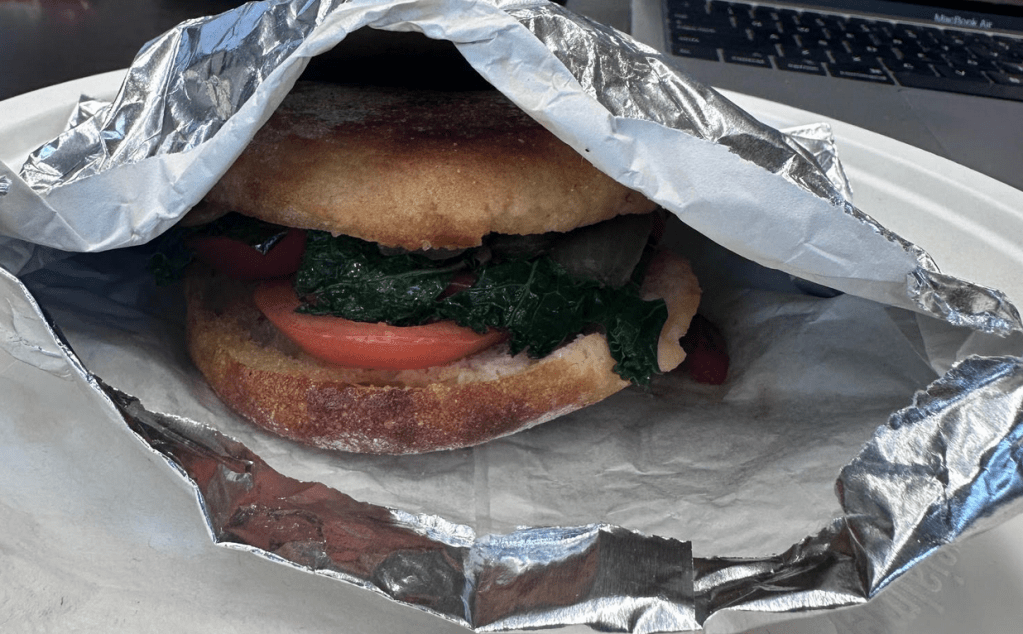
I realize I might be sounding ungrateful by now. But the reason I sound how I sound is that if plant-based was the default option it wouldn’t be nearly as pitiful. It was about the most unappetizing thing I have encountered in awhile. I’m not saying the other breakfast sandwiches are gourmet treats, but I have done a poll and people seem to think that they are more than edible. Tasty even. If everyone had a plant-based option, and if the “special orders” involving unsustainable options that support factory farming required people to opt-in (with an explanation for why they were trying to minimize the occasions on which they had to serve these things), the caterers would put more effort into creating decent plant-based options.
And despite my complaining, I think we lose the thread if we make it all and only about what tastes good. Prioritizing plant-based eating is not simply “catering to” some people’s “preferences.” Based on the evidence before us, there is little question that factory farming is rife with cruelty to animals, animal suffering, exploitation, and obviously killing.
Greener by Default is an organization that promotes plant-based as the default, and everything else as an explicit “opt-in.” Their mission is to consult with organizations, including universities and corporations, “to apply behavioral science to food policy, nudging diners towards sustainable plant-based food while preserving freedom of choice.” Their position is that people still get to choose, but they should be informed about what they are choosing.
Their strategy is simple: “Making plant-based foods the easiest and most appealing option for all diners, not just vegetarians, drives down demand for industrial meat production and normalizes plant-based eating, while offering options to meet everyone’s needs.”
As noted in my series on meat-eating as ideology and meat-eaters’ fragility, industrial meat-production is not typically questioned because of a deeply-rooted ideology that humans are superior to non-human animals and entitled to exploit, torture, and kill them for food. If instead we found a way to normalize plant-based eating so that it wasn’t regarded as “out there,” while still making it possible for people to make informed choices that might involve animal products, eventually the commitment to animal products might subside. If tasty options were made widely available, more people would be disabused of the myth of vegan food necessarily being unsatisfying, insubstantial, and bland. That’s why bad vegan catering really gets in the way of the process of change.
If we are going to make plant-based the default, it needs to be tasty. More powerful still, it needs to be offered within a context that explains why it’s such an important change. Then, if people still need to consume animal products, they will need to opt-in deliberately.


 Vegan Practically
Leave a comment