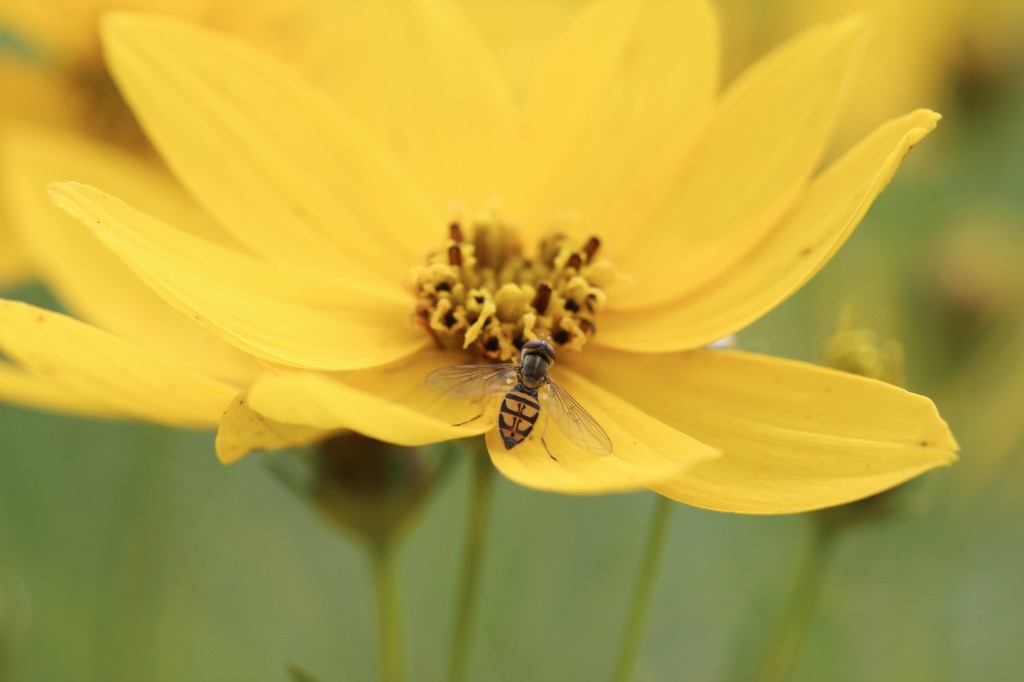
Lots of people wonder why vegans don’t eat honey. The short answer is that it is produced through the labour of bees, which makes it an animal product and therefore not vegan. You may find some vegans who don’t worry about honey, possibly because they don’t consider insects to be animals or possibly because they don’t consider them to be animals who merit moral concern. When I first became vegan back in 2011 I joined a vegan message board (remember those?). It was designed to assist people who were adopting a vegan lifestyle, which even a short 13 years ago was quite a fringe thing to do and information was hard to come by. One of the first rules was “We do not debate honey here. Honey is not vegan. Period.”
There is a lot to learn at the front end of transitioning to being vegan. I didn’t fully understand what made honey vegan, partly because I didn’t know if I considered insects to be animals (I’m not sure why I was uncertain, since they’re clearly not plants or minerals), and partly because I didn’t really know anything much about honey or about bees. But I decided that for the sake of consistency I would hold the line on honey. It generates confusion when vegans present themselves as super-flexible. The next thing you know people are saying, “but you eat fish, right?” So part of my reasoning was that it’s best not to be too public about exceptions. This is not to say I have never consumed honey or been imperfectly vegan in other ways since 2011. But for the most part, I am intentional in avoiding honey because it is not vegan and I don’t want to misrepresent what is included in the range of vegan foods.
Honey is indeed produced through the labour of honeybees. And it serves as a food source for their offspring and for the hive during winter months. Without it they would starve. As noted on the Vegan Society website, when beekeepers take the honey, they replace it with an inferior sugar substitute that lacks the micronutrients of honey.
An article in VegNews draws parallels between the honey industry and the dairy industry. Quoting from the article:
- Humans have been exploiting both cows and honeybees for 9,000 years.
- Like cows, honeybees are not native to North America and were imported to what is now the United States from Europe hundreds of years ago to work as agricultural animals. With the advent of modern agriculture after World War I, beekeepers began expanding their farms into much larger businesses.
- Honeybees are artificially inseminated, just like cows are
- In the same way that cows and calves are considered “expendable” by dairy farmers, bees are routinely killed before winter because it’s cheaper than feeding them.
- Humans profit from the animals in both industries by stealing their food and substituting it with an inferior replacement—in the case of bees, it’s refined sugar or high fructose corn syrup.
- Artificial feeds are insufficient for the bees’ needs and can have devastating consequences, as they can harm their immune system and cause genetic mutations that lower their natural defenses against pesticides.
- And because, unlike honey, high fructose corn syrup does not contain the protective enzyme a bee’s body needs to help fight off the toxins found in pesticides, feeding honeybees substitutes has been linked to CCD (Colony Collapse Disorder, wherein adult bees abandon hives, almost at the same time, and eventually die)
The above considerations make it difficult to dispute that bees are exploited for their honey and would be better off if no one took it from them. It is also really easy to find acceptable substitutions that don’t harm the bees: maple syrup, agave syrup, golden syrup, even “non-bee” honeys (I have some and it doesn’t really taste like honey though it has the same consistency and viscosity — this is likely an area that someone is working on) and other syrups made from dates or brown rice.
There are other issues surrounding industrialized honey, like cutting it with non-honey ingredients and threatening the more sustainable or “ethical” (in quotes because I need to explore whether there is truly ethical honey production) operations. This makes the smaller beekeeping businesses seek other income streams and has lead to the enormous migratory beekeeping industry, where beekeepers take their colonies to California to pollinate almond trees. If you want more information about the honey industry, watch episode one of the Netflix series Rotten.
That last point brings me to almond milk. Almond milk is my last-resort plant-based milk. I almost never use it, and if it’s the only option for coffee I will drink my coffee black. Between the Rotten episode I just mentioned, a documentary called The Pollinators, and something else I saw about bees but can’t remember the details of, I learned that the almond industry in California is a threat to native species and to the migratory bee colonies that are trucked in to serve it. The Guardian published an article in early 2020 (pre-pandemic) called “Like sending bees to war: the deadly truth about your almond milk obsession,” exploring a reported decline in commercial bee populations. They reported that “A recent survey of commercial beekeepers showed that 50 billion bees – more than seven times the world’s human population – were wiped out in a few months during winter 2018-19. This is more than one-third of commercial US bee colonies, the highest number since the annual survey started in the mid-2000s.”
50 billion. Let that number sink in.
Though some blame pesticides, environmentalists believe there is a systemic problem: “America’s reliance on industrial agriculture methods, especially those used by the almond industry, which demands a large-scale mechanization of one of nature’s most delicate natural processes.”
This systemic reliance on bees shipped in to pollinate threatens local and migrated bees. The war analogy used in the article headline is apt, given how many of the bees trucked from places like Michigan across the country to California never return.
In the US, “[c]ommercial honeybees are considered livestock by the US Department of Agriculture because of the creature’s vital role in food production. But no other class of livestock comes close to the scorched-earth circumstances that commercial honeybees face. More bees die every year in the US than all other fish and animals raised for slaughter combined.”
The article focuses in on one commercial beekeeper, Dennis Arp, who started sending his bees to California when he was no longer able to compete with cheap imported honey (see Rotten). But now he finds “himself in a vicious circle: he is constantly battling to keep enough bees alive to meet the requirements of his almond contract. But if he was not pollinating almonds, maybe his bees would be healthier.”
Though almonds are not the only industry that relies on pollinators, its demand is enormous, requiring ten times more bees than the apple industry (which is the second largest pollination crop). Moreover, “the bees are concentrated in one geographic region at the same time, exponentially increasing the risk of spreading sickness.”
We don’t need to feel too sorry for Arp, who is making good money through the almond industry. The bees themselves bear the main cost of doing business, paying with their lives, at a loss of 30-35% of migrated bees each year (remember: 50 billion). As one organic beekeeper describes it, the bees in California’s almond industry “are being exploited and disrespected.”
The systemic issue arises, as it does with all industrialized farming, when the animals involved are in the service of the financial bottom line. As human demand for these products increases, the stress on bee populations will increase apace.
Bees are not the only pollinators, but they are responsible for about 80% of the Earth’s pollination. If our systems of production put them at risk, then we put the entire food system at risk. The takeaway here is that bees are exploited for their labour in more ways than the production of honey.


 Vegan Practically
Leave a comment