
Bruges is a lovely town in Belgium, known for its beauty. Think well-preserved medieval buildings and quaint canals. It is also home to one of Europe’s oldest surviving hospital buildings, Sint-Janshospital, which is now a museum. The main hall where they used to care for patients has the grandeur of a church. It operated as a hospital from about 1150 to 1850.
The museum houses artwork representing caring for the ill, medieval surgical instruments, which are always strangely fascinating, and archival documents. The collection also has a number of works by the artist Hans Memling, a wealthy and famed Bruges artist (c. 1430-1494).
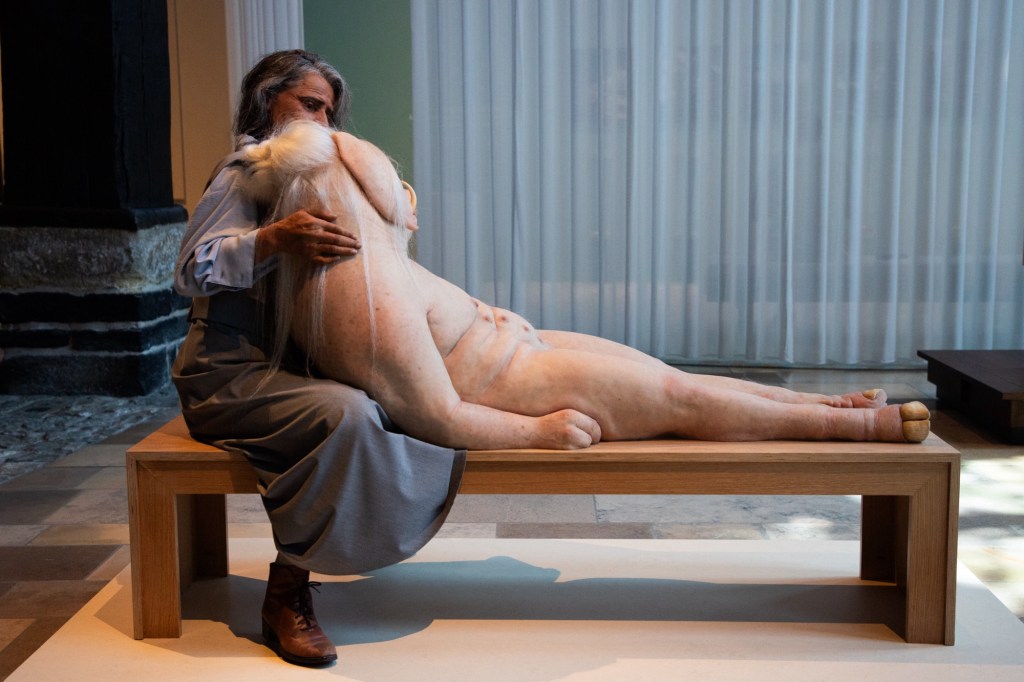
I was probably not appropriately attentive to the Memlings, not that they weren’t incredible works of great art. But the lifelike and life-sized ultra-realistic sculpture grabbed my attention immediately as I entered the hall. It’s called The Bridge and is a 2023 artwork by Australian artist Patricia Piccinini.
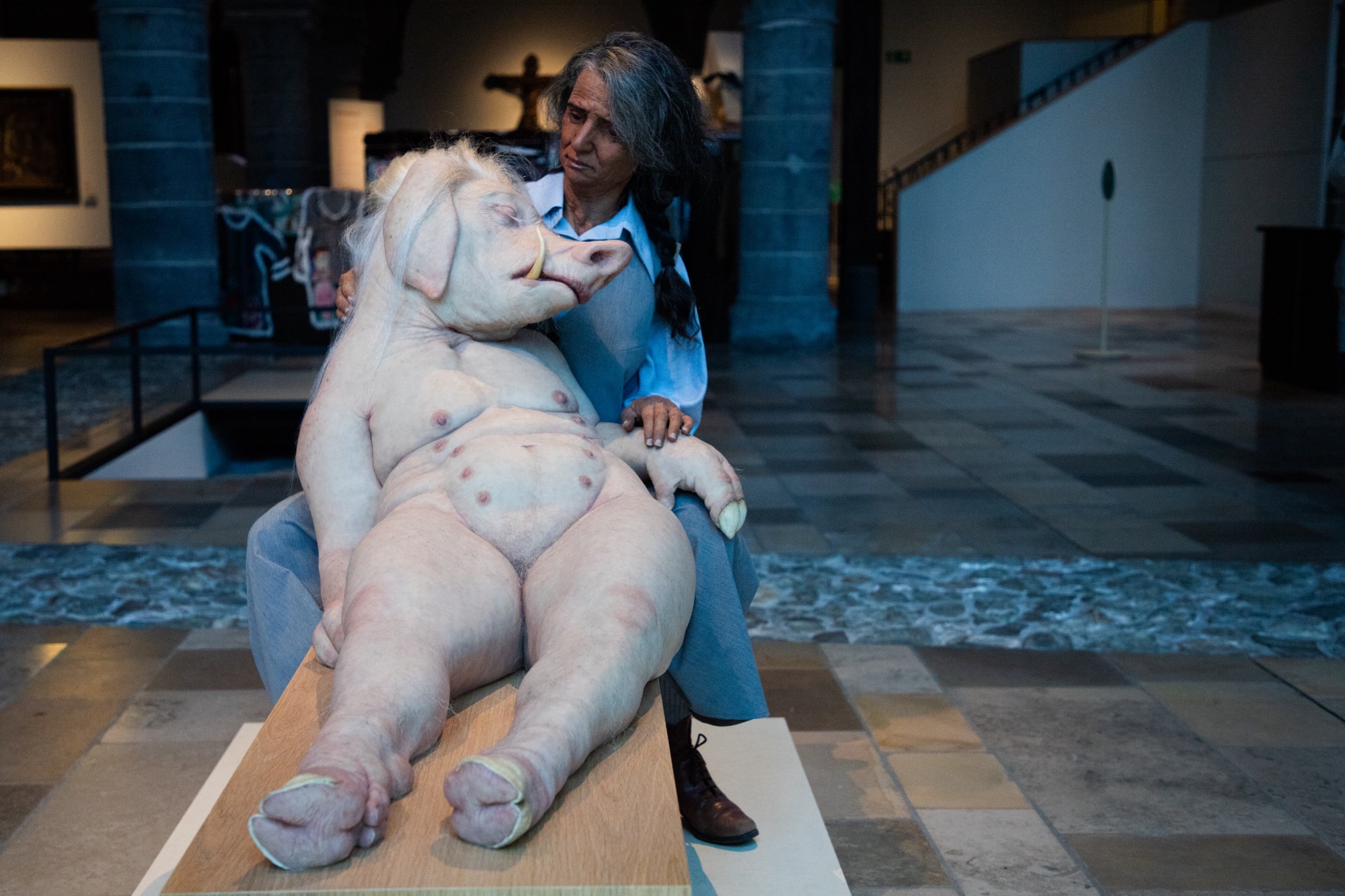
The website describes it as follows: “This artwork features a female character providing comfort to a hybrid creature with both animal and human attributes. Through the warmth of a natural-looking embrace, Piccinini skillfully evokes empathy for the creature, challenging viewers to overcome feelings of disgust and connect with the being that is out of sorts. The work is made of silicone, fiberglass, hair and textiles.”
The theme of empathy and what it takes for us to enact or experience it in relation to non-human animals is so important for considering their value. It is a lot for people to bridge the divide and want to care for but perhaps it’s less distance to develop a sense of caring about. I know that when I saw the sculpture it elicited in me a great surge of empathy for the apparently dying creature.
I’m no expert on the emotions, but it is a lot harder to eat those with whom we empathize. A friend has lately told me of complicated arguments she recently heard in support of eating animals. These have the do with drawing a distinction between factory farming and non-factory farming that takes place on a smaller scale and is supposedly more “humane.” While I endorse any measures to improve the sad lot of farmed animals, there is a very small range of scenarios in which their lot is not, ultimately, sad. And though I can’t speak for everyone who adopts this approach, my experience speaking to people who do is that they “do their best” to source the things they believe to be humanely raised, but in the end, if they’re out for brunch and want eggs benedict, they don’t ask about the origins of their meal.
I have also recently been exposed (not for the first time) to an argument for why a vegetarian tasting menu could not be veganized for foodie-gourmet type reasons. A small, high-end and quite exquisite restaurant in Bruges was unapologetically committed to using “fresh, local” dairy in “interesting” ways.
This reasoning is basically just an argument from taste, which is a terrible argument. It prioritizes human enjoyment (and in this case, not even enjoyment that most humans have access too for economic reasons) over extreme animal suffering and death. I realize that a lot of people think that the suffering and death of non-human animals is unimportant, but if you really think on it, there is a level of callous disregard in thinking that it’s less important than a tasty meal. Let’s say you could enjoy two equally good meals, each nutritious, delicious, and satisfying, yet one didn’t require animal harm and suffering. It seems fairly obvious that the cruelty-free choice would be the better choice.
But this is frequently the case, and people don’t feel the least bit compelled to make the cruelty-free choice. A little bit of animal cruelty seems, to many, a legitimate trade-off to make — easier to say when you’re not the one paying the ultimate price. Which brings me back to empathy, and the way Piccini’s The Bridge evokes it. It’s an incredibly moving work that demonstrates the human capacity to have empathy for non-human creatures. Offered in the context of a medieval hospital-turned-museum, it powerfully connects caring about and caring for.
If you can’t get to Bruges to see the sculpture in person, I highly recommend spending some time reflecting on its meaning and on your own capacity for empathy with non-human animals.
 Vegan Practically
Leave a comment