I am travelling home today from Costa Rica, where I participated in a long-awaited wildlife photography tour. As I like to do when I travel, I want to comment on what it is like to travel as a vegan in this part of the world. My comments won’t be representative of the whole country because other than a couple of nights in San José, we spent our time in the Osa Peninsula region to give us best access to an incredibly biodiverse part of the country. We stayed in one spot—the Botanika Resort—and did day trips out from there. In the evenings we went to different local restaurants.
A photography friend of mine with whom I’ve travelled quite a bit told the tour leader that I am an “extreme vegan.” 🌱 I suppose that is right in that I do my best to maintain my veganism when travelling. I have had my struggles where it was almost impossible (such as Brittany and Normandy in Northern France). I’m not sure my commitment makes me extreme, since anyone who practices anything for ethical reasons is usually committed to their principles. For the majority of vegans, it’s not just an arbitrary food preference. It’s a decision not to support a massive global industry that causes unfathomably vast animal suffering as a matter of course and has an enormous negative impact on the environment (see my post on Jane Goodall, where she cites the same reasons). I came to Costa Rica expecting that Diane and I wouldn’t have a hard time because of the emphasis on eco-tourism, biodiversity, and protecting the rainforests.
As it turns out, the emphasis on eco-friendly tourism does not translate smoothly into easy vegan options. It hasn’t been terrible—nothing like northern France—but no one seems all that concerned with the environmental impact of animal products or with the animal suffering that is inherent in the animal product industry. As usual when travelling with a group, our veganism needed to be addressed as special orders while the rest of the group ate animal products at every meal. It’s quite discouraging (as I’ve said before) because it makes it seem as if the only issue is “can we get a decent vegan meal.” In fact, the main issue is mass atrocity and environmental harm.
That said, it is possible to maintain vegan choices in Costa Rica, though sometimes that will mean going without protein. Some vegans might bear that well. I do not and opted for eggs a few times at breakfast. I hate doing that because I believe the egg industry is as bad as any other industry that exploits animals for human food. And I also hate sending the message to non-vegans that I am flexible. So that’s on me.
At breakfast each day, both at the San José hotel and at the Botanika, they had an abundance of fresh fruit, really good oatmeal, nice bread with choice of pineapple jam or papaya jam, and much to my surprise soy milk for my coffee and oatmeal. I wish they had nut butter for the bread, but that wasn’t an option at either place I had breakfast.
Most days on the tour we had lunch wherever we had spent the morning. So, for example, when we visited a property where sloths lived, we had lunch there. When we went to a family-run chocolate plantation, we had lunch there. And a couple of times when we had macro mornings where we photographed things like frogs, reptiles, snakes, and insects, we ate at those places (and no one ate frogs, reptiles, snakes, or insects).
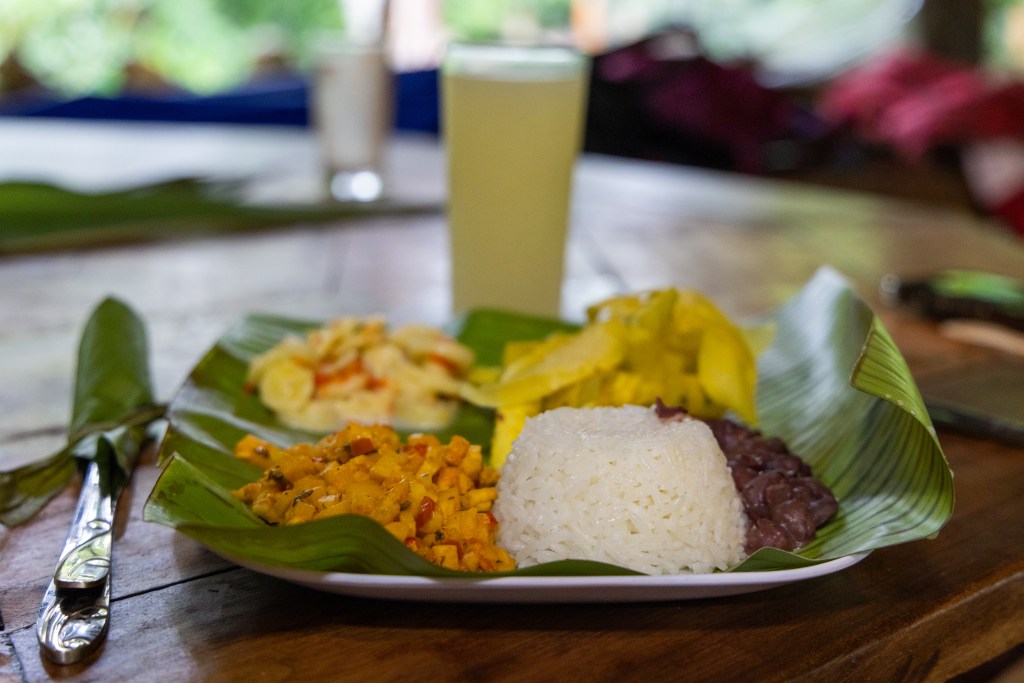
Lunch at these local spots, all of which were family-run, was usually some version of a Costa Rican mixed plate called casado. It typically has rice and beans (not always beans), some other usually animal product protein, plantain or banana, salad or veg. It really varies. Every place seems to have their own version of it. They all accommodated our veganism even if not our nutritional requirements. Once we had some sort of cauliflower pancake in place of the protein and that time no beans. Other times we were served more of the other stuff. Sometimes we got beans and the others didn’t. The couple of times we had lunch at the hotel we got a falafel bowl or some variation of that.
Dinner was at local restaurants in Puerto Jimenez, the small town nearest to the resort. It was great to get out and support the local economy, and these dinner outings made for pleasant evenings. We tried four different restaurants, and returned to three of them for a second evening. We had excellent pizza, with perfect crust and tasty toppings, but no vegan cheese so we went without cheese. Other meals included pesto pasta, rice with veggies, and vegan tacos — none of these included protein, but they were enjoyable enough. Once we had a veggie burger with fries, and the restaurant where we had that labelled several of their items as vegan. It was the only place that had items listed as “vegano.” Once we ordered a mixed salad, which I had misunderstood to mean mixed greens but turned out to include cheese, deli slices, and a mayo-based creamy dressing. Overall, I would say that the restaurant experiences were enjoyable and the food was fine. But I would not have been excited to cycle through those same places for another week.
I’m not sure if there are destinations within Costa Rica where they more explicitly connect concern for animals and the environment with the consumption of animal products. I would have hoped for more. As I have said before, travelling with a group as the only vegan (this time I had Diane with me, so I was not alone!) can be disheartening because literally no one cares about the ethical and environmental implications of what they eat. It’s okay at first but I do find day in day out of three meals a day at the table with omnivores to be challenging. It’s a lot of saying nothing, trying to get nutritional requirements met, and being labelled as “extreme” because you want plant-based milk. I am not sure what that is supposed to mean. I really don’t know any vegan who would opt for cow’s milk, so it’s hardly an extreme request.
In any case, this is always going to be an issue with group trips that are not specifically vegan. I haven’t really figured out an approach other than keeping my reasons to myself unless asked. On this trip, no one asked. I only made one little slip, which was when for some unknown reason on one of the day trips we were shown a pen of pigs on the property (which had absolutely nothing to do with the reason we were there), I said, “why would anyone want a photo of the pigs on death row?” More than anything I think comments like that send people running rather than pique their curiosity (though it doesn’t take a lot of curiosity to grasp that animals destined to be slaughtered for food are, effectively, on death row).
My overall assessment, setting aside the issues of travelling with people who are not vegan and not concerned about the ethics or environmental impact of the food systems in which they participate, is that Costa Rica gets a B- for vegan options and a B+ for effort. The tour organizers conveyed what we needed. It’s not a vegan tour, so realistically we can’t expect anyone to do more than that. And the restaurants and our hosts on the various excursions did provide vegan options, even if they didn’t hit all the nutritional notes. The meals were good, though sometimes there was the lack of protein and the issue of everyone else getting carrot cake while we had fresh fruit. But vegan baking is another level of accommodation. Expect to occasionally be surprised but for the most part, if you want vegan dessert in Costa Rica you’ll get fruit. It’ll be delicious fresh fruit to be sure. But when you want cake or mousse, and you already had fresh fruit at breakfast, it is as disappointing to get fresh fruit for dessert if you’re vegan as it is if you’re not.
Go in with reasonable expectations and you’ll find your way in Costa Rica.
¡Buen provecho!


Leave a Reply