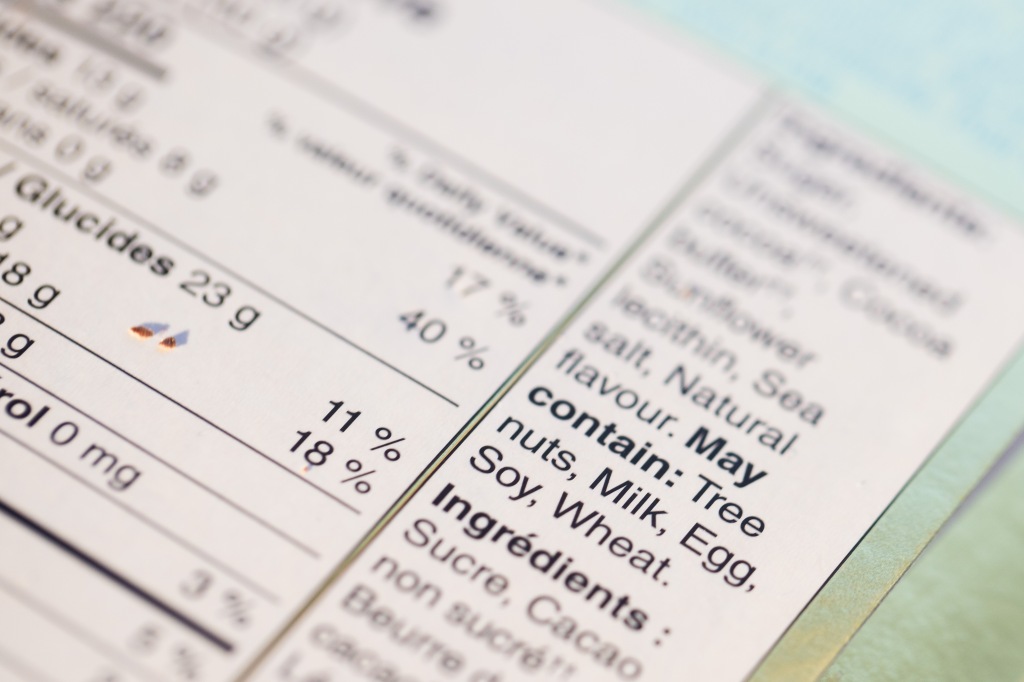
Anyone who has ever spent time reading ingredient labels to see if a product is vegan is aware of the frequently-seen “may contain” warning. This warning is usually associated with known allergens, and most often will list tree nuts, soy, wheat, dairy, or eggs.
I confess that I have usually considered this warning to be drawing attention to a very outside chance, mentioned more for legal due diligence. Since I have no allergies, I don’t avoid products that have a “may contain” warning about animal products. But is that the right thing to do if I am vegan for reasons of animal suffering and the environment?
An article from The Conversation entitled, “Allergen warning: ‘vegan’ foods may contain milk and eggs,” came across my feed yesterday that discussed the issue of foods marked vegan that may contain some of these allergens. Their central question was not “what should a vegan do?” but “what should someone with one of these allergies do?” I have a friend with a deadly peanut allergy whose approach to “may contain,” even when it comes to peanuts, is moreorless the same as mine when it comes to the possible presence of animal products. Both of us, clearly, consider the possibility that the product does contain those ingredients to be remote.
The study the article reported on asked several hundred people with milk or egg allergies (or parents of allergic children) whether they include “may contain milk [or egg]” products in their purchases. The study found that “Of the 337 respondents, 72 per cent said they sometimes included these products in their purchases, 14 per cent said they always did, and 14 per cent never.”
I would say be interested in results for a similar question put to people who are purchasing vegan foods because they’re vegan, not because of allergies. My guess is that the numbers would be similar. But the possibility of cross-contamination, wherein vegan or accidentally vegan products are manufactured or processed in facilities that also produce or process non-vegan products, however remote, is not the only concern an ethically-motivated vegan might have.
Again, the question is about where we draw our lines. If something I am selecting “may contain” animal products, then the manufacturer whose profits I am contributing to uses animal products in other things they make. It’s one thing not to consume such products. That may be where we draw the line. It’s quite another to avoid supporting any manufacturer who produces them.
We make these decisions all the time, and I think for simply logistical reasons the majority (as we see with the allergic folks too) focus their attention on specific products. Like when I go out for dinner with omnivores, I go to restaurants that serve animal products even though my strong preference is to go to restaurants that are fully plant-based. Almost every time I go out with a group, I sit at a table with people eating animal products, in a restaurant where they serve them. Based on the small sample of people asking questions about where to go out with a “mixed group,” that’s the case for lots of people.
But some are more strict, refusing to sit at tables where someone is consuming animal products and refusing to purchase from manufacturers who use animal product ingredients in any of their items. In so being, these folks are more consistent in their vegan practice. As philosophers who have ever considered “the demandingness objection” to utilitarianism are aware, sometimes ethical consistency requires more than we can reasonably accomplish. This is not the same as “ought implies can.” It is not completely impossible to do more to arrange your life in this more consistent way. Again, there is disagreement about how demanding something is before it becomes too demanding. Some people think it is too demanding to be vegan at all. Others think it is too demanding to choose plant-based options more than once or twice a week (the Meatless Monday crowd). Still others think it is too demanding to avoid restaurants or manufacturers who offer products that include animal products even if they have plant-based options.
I would myself among the latter group. I make my best effort, and though I will always choose a fully plant-based restaurant over an omni restaurant, I also care about my relationships with friends and family who draw their lines elsewhere on the food front. Moreover, it makes sense to support plant-based options and plant-based menus in order to make it clear that there’s a market for them. But where we might recognize that maintaining our relationships is an important value, is it equally important to buy chocolate bars made in facilities that also make animal products?
To be perfectly honest, I have not explored the tangible impact that dispensing with “may contain” products from my range of options would have. How limiting would it be, in the end? It would probably eliminate almost all accidentally vegan foods. But as I think this through, it seems to me worth investigating as an area for reducing, if not eliminating, my latitude.
If you’re vegan or have allergies, what is your approach to “may contain”?


 Vegan Practically
Leave a reply to Tracy I Cancel reply