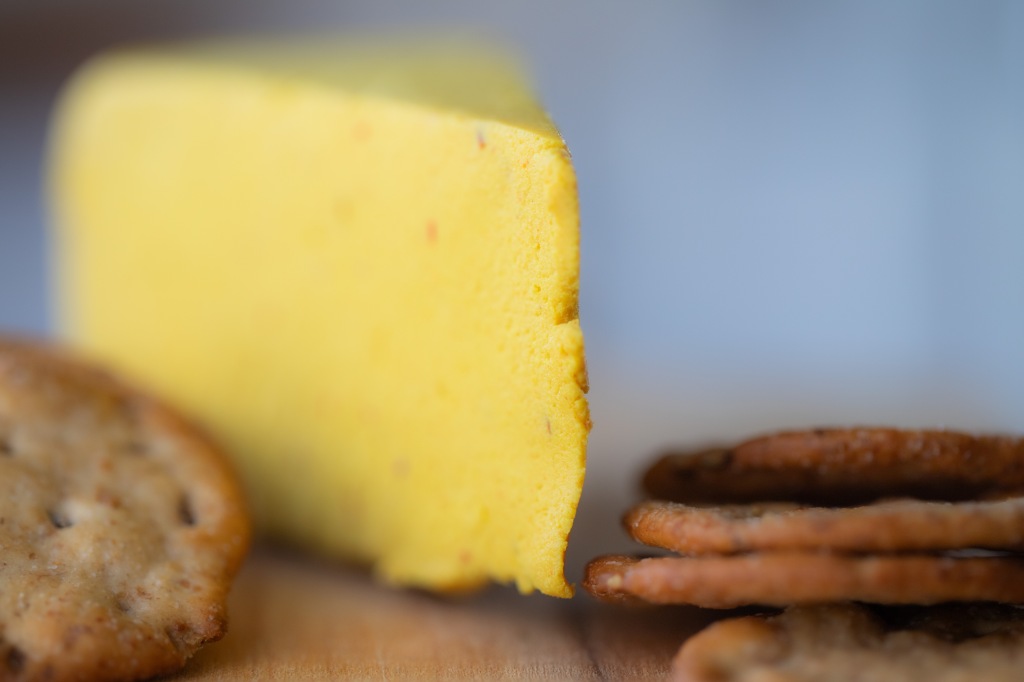
An interesting story from The Washington Post came across my desk the other day about a vegan cheese that was a finalist in a cheese competition “A vegan cheese beat dairy in a big competition. Then the plot curdled.” The Good Food Foundation is an organization whose “Good Food Awards” recognize exceptional producers in the craft food industry in the US. Earlier this year the finalists in the cheese category included a fully plant-based blue cheese from a company called Climax. Their entry is made of “a blend of ingredients including pumpkin seeds, lima beans, hemp seeds, coconut fat and cocoa butter.”
That a plant-based cheese could hold its own in a competition like this shocked the dairy cheesemakers and created a controversy that resulted in a compromise: “If, in fact, the Climax cheese was a winner, it announced, the foundation would name a co-winner. Then the foundation would reevaluate for next year, perhaps creating a new category or moving them into the broader snacks cohort.”
Ultimately, the Climax entry was removed from the list of finalists because someone filed a complaint that it failed to meet entry-requirements (not because it was plant-based, mind you, since that was never a requirement).
The CEO of Climax added further to the controversy: “Climax CEO Oliver Zahn accused the foundation of caving to pressure from dairy cheesemakers in revoking the award. And then he spilled the curds:Climax, it turns out, wasn’t just a finalist — it was set to win the award, a fact that all parties are asked to keep confidential until the official ceremony in Portland, Ore., but was revealed in an email the foundation sent to Climax in January.”
Whatever the reasons, it’s clear that dairy based cheese producers are worried. It used to be that vegan cheese was awful. But now that it can go toe to toe with dairy, the cheese devotees lament that they “could never give up cheese” is losing traction. And it’s causing the cheese industry to dig in just the way we’ve seen in the case of meat and milk — vegan cheese shouldn’t be allowed to call itself cheese, they say.
In the wake of this debacle, “Is Cheese a Dairy Food?” appeared on Janet Fletcher’s Planet Cheese website. She opens by saying: “The cheeses I love are a collaboration between humans and animals.” And then, prompted by the Climax Blue’s performance in the Good Food Awards, asks, “Is it time to redefine cheese in a way that embraces non-dairy alternatives?”
A recurring theme in the industry people she quotes in her article is that plant-based cheese isn’t “cheese,” it’s “chemistry.” Others are less dismissive, but hold to the view that cheese involves dairy, and the plant-based alternatives should not be allowed to call themselves “cheese.” And finally, one of the industry folks says: “Cheese is a story. It’s a story of place, animals, cheesemakers, art and science. Even if we don’t know that story, we can taste it. A good cheese is transformative, even if just momentary. The story of plant-based foods starts and ends in a factory…Cheese has meaning that plant-based foods simply do not.”
Given that 99% of animal products consumed globally are the products of factory farming, the “story” that cheese is is not a happy story. And it’s not clear that knowing the history of “animal-human collaboration” (as cited above) is actually front of mind when someone is eating a good cheese that is “transformative.” Surely an equally good but cruelty-free product would have the same transformative powers.
Granted, the Good Food Awards focuses on a more artisanal range of products that we would normally associate with craft producers operating on a smaller scale than factory farms. It would be unfair not to say that at least some of the finalists are committed to sustainable farming practices such as rotational grazing and such, claiming grassfed cows. But in my perusing of the finalists’ websites, only Grey Barn in Martha’s Vineyard, a small operation with 45 cows, explicitly outlines a “more humane” approach to their livestock. I recognize that from a strategic perspective, given that people will not give up animal products, some might claim that these smaller operations that (maybe) have more humane conditions for animals and almost certainly are making an effort to farm in a more sustainable way, ought to be encouraged and applauded. That might be a discussion for another day.
For the record, my main concerns about that line of reasoning are that first, even if smaller dairy operations could create “humane” conditions for their cows, this type of approach can’t possibly meet consumer demand. Hence, the root of the issue — that as long as people continue to consume animal products in the volume they do, factory farming will be necessary — is not resolved. And second, that’s a big “if,” given that dairy cows need to be kept in a near-constant state of pregnancy in order to produce milk and there is really no non-exploitative way to use animals and their products to support humans’ dietary preferences.
The main thing I read in this story of the Climax Blue Cheese is fear. It is a good illustration of the kind of gate-keeping that kicks in when it becomes difficult to justify cruelty and exploitation in the face of equally tasty cruelty-free and more sustainable alternatives.
 Vegan Practically
Leave a comment