
I’ve been thinking about spice ever since last Sunday, which was “Spice Week” on The Great Canadian Baking Show [sadly the show is not vegan but I can’t help being in love with it anyway]. Then I got a note from Shelley asking if I had anything to say about herbs and spices. So it seems somehow providential that I should write about herbs and spices. I’ll save fresh herbs for another day. Today I am going to talk about dry herbs and spices. Keep in mind I am no expert. But I will touch on four things: 1. how I like to use them, 2. how I store them, 3. how long to keep them, and 4. where I buy them. I might say a bit about whole versus ground spices along the way.
I grew up in a South African home where curry was a frequent dish, so I have long known that spices release their beautiful fragrance and flavour when they are thrown into a sautée of onions and stirred around for a bit before adding the rest of the ingredients. My mother is a brilliant cook who fed us well throughout our childhood (and still does, when she gets a chance). I can still hear the sound of onions frying in the pan, and I can easily call up the aroma of the moment when the curry powder and cloves and maybe a cinnamon stick was added.
Spicy doesn’t necessarily equal hot, but I do like some heat. I’m the person who shakes the dried red chili peppers onto her pizza and pasta and who never says no when the restaurant server comes around with the pepper mill.
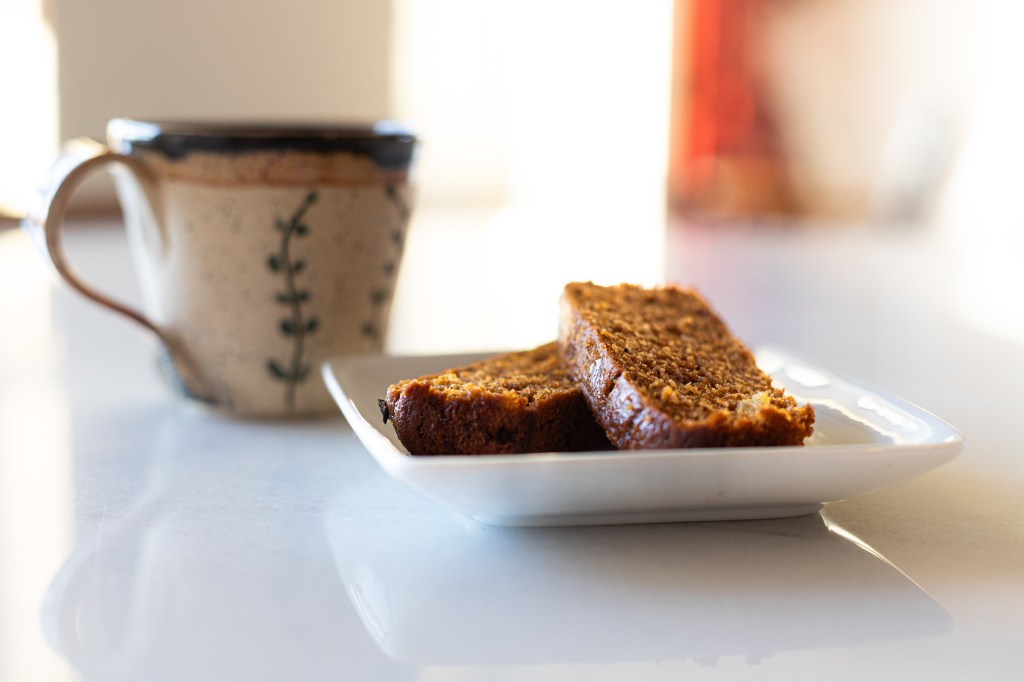
I also like sweet-spicy. When Shelley emailed me she mentioned being obsessed with ginger of late. That etched ginger into my head for the rest of the week, culminating in me baking not one but two ginger loaf cakes to take with me to Toronto this weekend. These cakes have a lovely spice combination of ginger, cinnamon, cloves, and nutmeg. I made one last night to test the recipe, and then the second this morning after confirming it as a success.
How I like to use spices. It’s really a matter of using what particular dishes/recipes require, and different people like different levels of spice. So take what I have to say here with a grain of salt (fun fact: salt is a seasoning but not a spice because it is not plant-based — rather it is a mineral), as it’s subjective. I don’t enjoy bland food, so I seek out recipes that have good seasoning, whether herbs, spices, or some combination of the two. I keep a jar of cinnamon on the kitchen counter along with the salt and pepper because I like to put it in my breakfast oatmeal. I make a lot of stir-fries, into which I almost always add a good amount of dried red chilies.
If I am making tofu scramble (better than scrambled eggs and cruelty-free) for breakfast or tofu “egg” salad (better than egg salad and cruelty-free) for sandwiches, I add some turmeric for flavour and colour, possibly a bit of curry powder as well (keep in mind that curry powder is a blend of spices that usually includes cumin, turmeric, ginger, pepper, and sometimes other things like cinnamon, dried mustard, coriander, ground fennel seeds, and maybe ground cardamom, depending on the brand–that’s why you’ll find such a large variance from one curry powder to the next).
I like chili (of the formerly “con carne” variety) and for that I use lots of chili powder, some extra ground cumin, and sometimes a bit of cocoa (I don’t know if cocoa counts as a spice but it does add richness to chili and if you haven’t tried it you’re missing out!). Nora Cooks has a fantastic vegan chili recipe with cocoa. Often I will make just the tofu crumbles part of her recipe and use the tofu for tacos, taco salads, and nachos. So good.
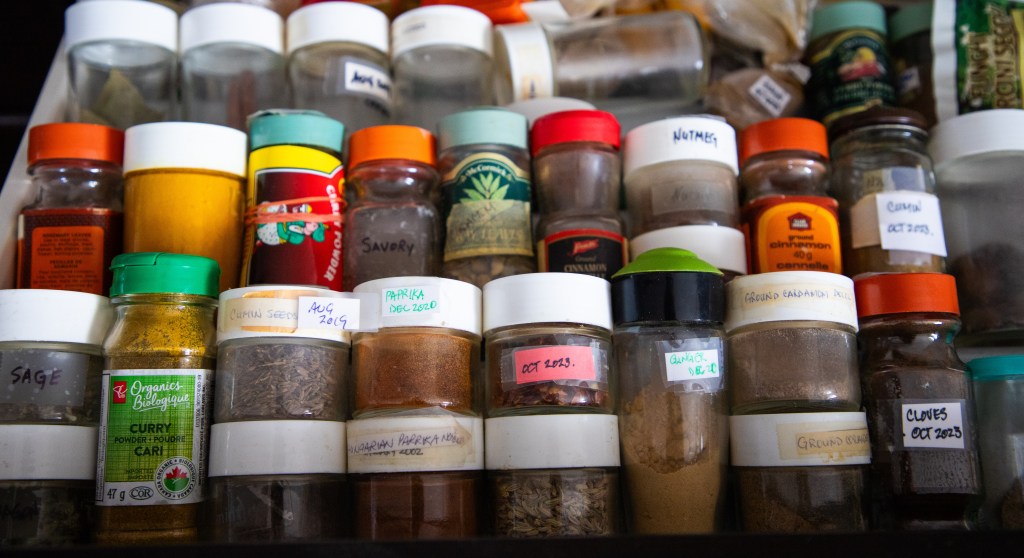
How I store spices. Spices do best when they are in a cool dark spot and out of direct sunlight, which will make them lose their flavour more quickly. I keep mine in a kitchen drawer with a special rack inside that is designed specifically to maximize storage space for spice jars. That photo at the top is my actual spice drawer. As you can see, I keep my spices in jars, which I keep and refill and label them with the date.
The jars aren’t all the same size — indeed, off to the side, not pictured, there is a separate more open (no rack) section of the drawer where I have some larger jars for things like chili powder and cocoa, which are usually needed in larger quantities, by the tablespoon, and so are easier to work with when they’re in a wider-mouthed jar.
The main message about spice storage is: not on the wall or on the counter where they will be consistently exposed to light (or heat, so not near the stove), which depletes their potency.
How long to keep them. I have some spices in my drawer that are more than a decade old. They are not spices I use often (like, haven’t used them in ten years or more!) and if I come across a recipe that calls for something that I’ve had for more than two or three years, I will usually retrieve the old jar, dump it, and refill it with fresh spice. For the spices I use more regularly, I don’t have to worry about them sitting around long enough to lose their punch. But if they’re special (like I had some curry powder from South Africa that I couldn’t easily replace), I will store them in the freezer. Then the trick is not to forget about them.
It’s easy to let spices languish in a drawer or on a rack for years and years. Almost everyone who cooks a lot has old spices sitting around. But they will not be what they need to be if they are left for that long. Ground spices do worse over time than whole spices or seeds. So for example, whole cloves might stay potent for 3 or 4 years whereas ground cloves could start losing flavour within a year; cinnamon sticks last longer than ground cinnamon; whole nutmeg lasts longer than ground, etc. Properly stored dried herbs are good for 1-3 years (apparently). Keep in mind that it’s not as if they go bad. They just don’t serve their intended purpose once they’re too far past their prime. The result: bland food.
Where to buy them. Replacing old spices is not expensive if you do what you can to avoid the spices purchased in jars from the grocery store unless there is absolutely no alternative or you know you really like a particular brand. I almost always purchase my spices at the bulk food store in much smaller amounts than you would find in the jars at the supermarket. They weigh almost nothing, are priced by weight, and so they cost almost nothing, often under $1 as compared to $5 or more for a jar of spice from the supermarket. If you buy smaller amounts, which you can do at the bulk food store, then you end up throwing way less away.
Another good option for spices is the international aisle at the grocery store, where they often have larger bags of spices for much cheaper than in the spice aisle. And then of course there are specialty grocery stores that specialize in ingredients and products from different parts of the world. They will have a huge selection of good quality spices frequently used in the cuisine to which they cater. Walking into an Indian grocery store is a wonderful sensory delight.
So that’s today’s Spicy Saturday post. I didn’t talk about mortars and pestles or coffee grinders set aside as dedicated spice grinders because I don’t do that. But of course if you have seeds and whole spices and grind them in a mortar and pestle or a grinder (don’t use the same grinder for coffee and for spices though), your freshly ground spices will be better and more flavourful provided the whole spice you start with is still good.
The best thing about spices, which I almost failed to mention, is that they are vegan! Whoever said vegan food was bland and unappetizing is, once again, just plain wrong.
Bon Appétit!
 Vegan Practically
Leave a comment