
We have a breakfast and lunch place near us in Toronto called Evviva. They have two menus. One is “regular” and the other is a full plant-based menu, the most extensive I’ve ever seen for breakfast and brunch. You can get scrambled or sunny-side up eggs with your plant-based bacon and sausage. You can get plant-based Benedict. You can get waffles or pancakes. And…wait for it…steak and eggs.
We have been intrigued by the steak for months. It’s quite expensive and these things can be hit and miss. But the waiter said it was a good thick piece of steak, only slightly less chewy than animal steak. So finally Diane decided to order it.
She got a thick and juicy portion of extremely tasty steak. On the plate it looked like a ribeye (they call it the “prime steak”). I haven’t had meat in decades and to me it had a very meaty but not unpleasant texture (I wish I had a photo but I remain terrible at remembering to take photos of food in restaurants, partly because I don’t think iPhone pics ever make anything look particularly appetizing). Next time we go there for lunch I might try the prime steak entrée, which comes with veggies and salad and potatoes.
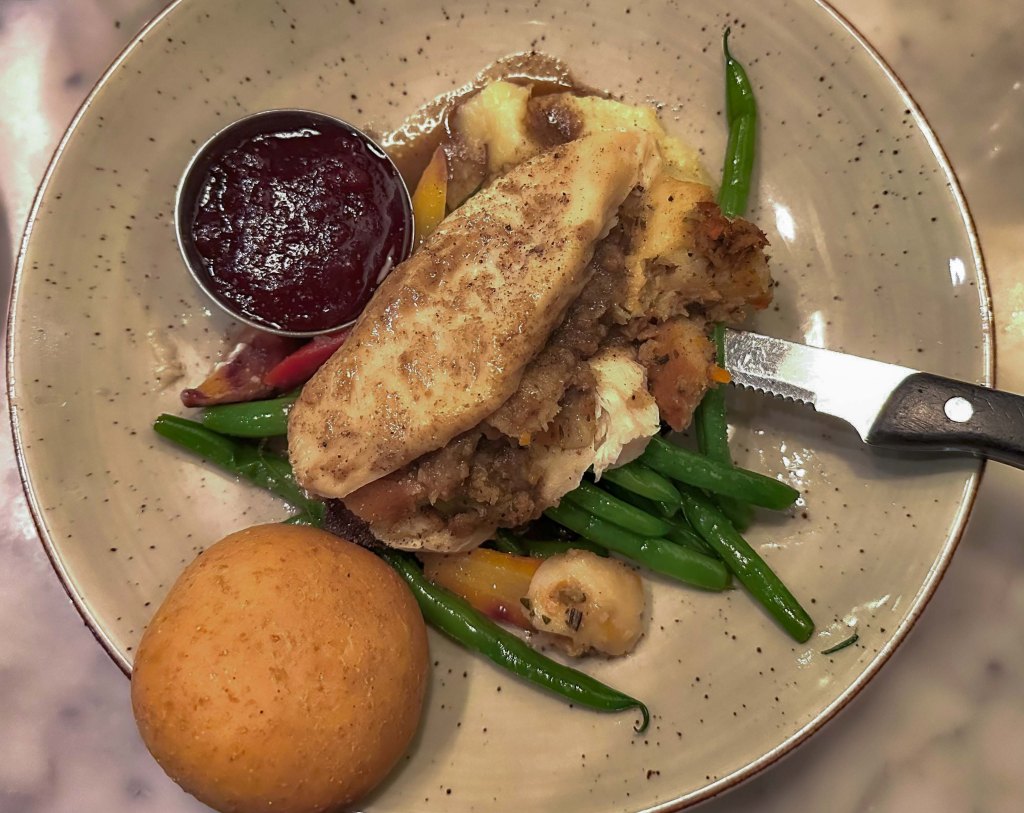
A few days later we checked out the Festive Vegan Dinner at Il Fornello on Danforth (in Toronto). For $24.95 you get oven roasted plant-based chicken stuffed with apple sausage stuffing served with mashed potatoes,
seasonal vegetables, mushroom gravy, cranberry sauce, whole wheat roll and vegan butter, plus a vegan Lindt truffle, and an IL FORNELLO 20% off dining voucher. It was our first time there and the owner, Stacey, was super welcoming. She gave us a complimentary vegan Caesar salad while we were waiting for our festive dinner and it was delicious. Then came the main event, and we both agreed that it was the best meal we’ve had since coming to Toronto.
Maybe our judgments are at this point relative, but it wildly exceeded our expectations. We have learned to aim low when ordering things that are trying to be vegan versions of familiar meat-focused dishes. In this case, a piece stuffed roast chicken. But it was so authentic, in texture, taste, and appearance, that I had to confirm that we had been served the plant-based meal. And it wasn’t just authentic, but it was juicy and tasty and served with perfectly cooked veggies and cranberry sauce. It had been recommended several times on the Toronto Vegan Facebook group, as has the restaurant more generally because it has a full plant-based menu alongside the omni menu.
The festive dinner ends on Christmas Day, but we will be back soon to try the pizza and other Italian offerings that everyone speaks of so highly.
All this is by way of preamble to the idea, expressed in a forthcoming (Feb 2026) book called Meat: How the Next Agricultural Revolution Will Transform Humanity’s Favorite Food — and Our Future, that affordable and tasty plant-based and cultivated meats are the only way to transform animal agriculture. People are not going to lose the taste for meat and they are not going to sacrifice satisfying that taste in sufficient numbers to yield significant change. The author, Bruce Friedrich, founded the Good Food Institute, a non-profit think tank devoted to accelerating the development of meat-alternative proteins. The agenda is not soley focused on plant-based meat. It also includes cultivated meat, that is, lab-grown meat cultivated from animal cells.
The focus of the book and the Good Food Institute is the environmental impact of meat production. In a world where global meat consumption is increasing year over year, the switch to plant-based and cultivated meat would reduce the carbon footprint of meat production considerably. If the alternatives were tasty, affordable, and convincing enough to replace meat from actual animals, they anticipate immense environmental benefits. The home page of the institute says: “Producing meat from plants, animal cells, or via fermentation can help meet that growing demand in ways that strengthen and diversify global supply chains, conserve land and water resources, reduce emissions, protect public health, build thriving bioeconomies, and help usher in a new chapter of agricultural innovation.” Friedrich’s forthcoming book promises to help make that case.
I have to agree that there is no way to convince enough people to give up meat and animal products more generally. The number of people who think that “I love my burgers” and “I can’t imagine life without bacon” and “there is no way I’m giving up cheese” are stand-alone arguments for continuing to consume animal products is astonishing. Indeed, the majority of consumers of animal products dismiss both the environmental concerns and the animal suffering concerns with a casual shrug. People regard the idea of giving up meat for either of these reasons as extremist.
Friedrich used to work at PETA (though, interestingly, that is not on his Good Food Institute bio). His shift to environmental concerns over animal rights is strategically smart. Even animal lovers don’t care enough about animals to change their eating habits. But we are all living on a planet in peril. His decision to make the environmental case and offer a promising solution indicates a good grasp of reality. If people like meat too much to give it up, then the prospect of environmental ruin AND tasty alternatives that have a much lower carbon footprint together could lead to a shift.
There is still work to do. Lots of people still recoil at the idea of lab-grown meat. It is difficult to understand why someone would prefer meat that comes from a slaughtered animal if the alternative involves no suffering, no slaughter, and is identical at the cellular level. Like, if we get to the point where it is truly indistinguishable, why prefer a dead animal? And lab-grown meat isn’t strictly vegan, since it requires animal cells for cultivation.
Even more mystifying is the way people recoil at plant-based meat. Again, where indistinguishable, what’s the argument here for choosing a dead animal? I don’t think anyone who was served the vegan festive dinner at Il Fornello would know it is vegan just by look and taste alone.
Granted, that’s still rare. We aren’t yet at the point where there’s a lot of variety of plant-based meats that are indistinguishable from meat that requires the raising and slaughtering and processing of animals. But the direction of the Good Food Institute seems right to me. And I will be reading Friedrich’s book when it comes out in February.
It’s terribly sad and frustrating that the animal suffering arguments against factory farming get so little traction, even among so-called animal lovers. At some point, when the alternatives to the products of intensive animal agriculture become truly competitive in price, taste, and texture, the reasons to continue eating animals might well lose their force. We can only hope.
Meanwhile, if you are in the Toronto area and want to experiment, go try the vegan steak at Evviva or the vegan festive dinner (until December 25) at Il Fornello on Danforth.
 Vegan Practically
Leave a comment